
 I make no secret of my hate of superhero comics. Not comics in general - I love comics - but specifically the type popularised by Marvel and DC, the type Joe Average will think of if you mention the word "comic" to him. Sure, they're great fun for kids, but when graphic novel sections of bookshops become dominated by characters in silly outfits fighting each other, it's no surprise no-one takes the artform seriously.
Anyway, the only types of superhero stories I enjoy are those in which a talented author purposefully plays with genre conventions, such as in Alan Moore's work, or re-interprets the "mythos" of a classic characters such as in Frank Miller's The Dark Knight Returns.
Superman: Red Son falls into the latter category, re-imagining the Man of Steel as a Russian-born communist who turns the tide of the cold war for Soviet Russia. Much praise has been lavished upon Mark Millar for not portraying the Soviets and Stalin as evil villains - but honestly, in this day and age shouldn't this be seen as an expectation rather than a breakthrough? Millar never goes as far as to actually explore communism's ins-and-outs, simply allowing Superman to tell the reader how committed he is to the cause. (Again: is this really cutting-edge stuff for the US? Have they not got over their Red Fear yet? Then again, this is the country that considers Obama a socialist.)
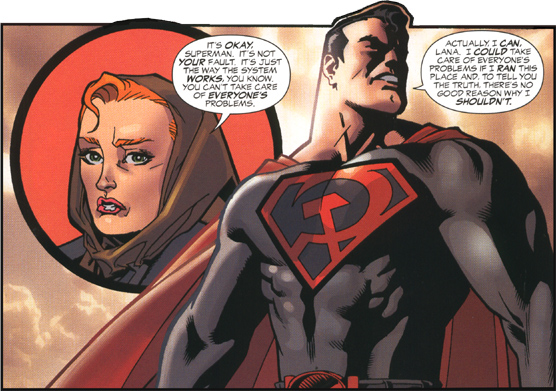 To his credit, Millar cleverly subverts the cold war arms race: instead of stockpiling nuclear deterrents, the US produces a series of supervillains to fights Superman. (We never actually get to see any of these fights, although presumably they'd play out like in any other Superman comic.) Superman's arch-nemesis is, as in the regular comics, super-genius Lex Luthor, who is introduced playing fourteen simultaneous games of chess while reading Machiavelli's Il Principe during a coffee break - when Mark Millar writes super-geniuses, he doesn't do half-measures. The rest of the cast are re-imagined - well, to an extent - DC characters: Wonder Woman, Batman, Lois Lane, Brainiac and the Green Lantern. The best of the lot is the Russian anarchist Batman who attempts to bring down Superman's communist state.
Unfortunately, Millar loses any pretence of exploring complicated political issues by the halfway point and instead goes for some obvious moralising about the downsides of oppressive totalitarian regimes and obligatory mindless fight scenes between superheroes. Its epic pretensions are far beyond the depth of the story and the ending (which is either "OMG GENIUS" or entirely pointless depending on what side of twelve years old you are) reads like bad fanfiction.
Let's be honest: Red Son is an attention-grabbing stunt of a book with only a couple of good ideas to its name. While a decent read, it's painted with such broad strokes that it relapses into the very hyperbole that "groundbreaking" graphic novels such as these are supposed to be subverting.


